

Your SaaS product team ships new updates every sprint, including redesigning dashboards, adding AI copilots, and polishing onboarding flows. Yet activation stays flat, support tickets keep piling up, and expansion revenue from existing accounts barely changes.
This is all engineering and business driven. That’s a strong indicator of a lack of UX design strategy. It costs a lot in 2026 than it ever used to.
It happens because there is no shared answer to a basic question: what is this experience supposed to do for the user and the business at the same time? Without that answer, there’s no evidence to prove if this experience is actually going to be helpful to users and the company.
A clear UX design strategy fixes that.
In this extensive UX strategy guide, you’ll learn what it actually means, why it has a measurable effect on SaaS growth, how to build one for your product, and what changes once AI sits inside the experience you’re designing.
Let’s get into it.
What is a UX Design Strategy?
A UX design strategy is a deliberate plan that connects user needs, business goals, and design decisions before anyone touches a screen. It gives your team a shared answer for what kind of experience you’re trying to create and why, so design choices stop getting made in isolation.
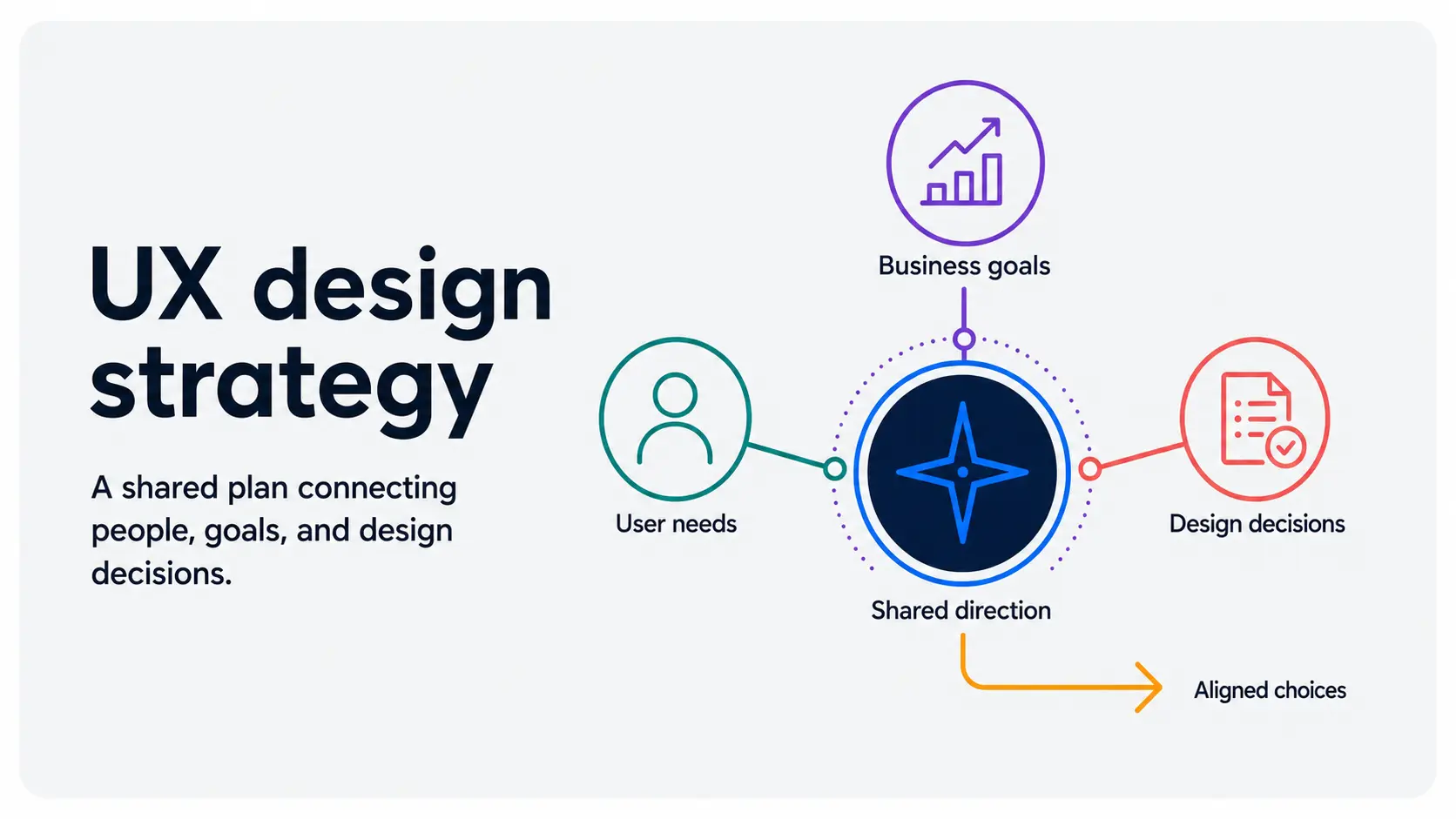
Nielsen’s UX strategy framework breaks this down into three parts: a vision for the experience you want to create, goals and measures that tie that vision to outcomes, and a roadmap that turns both into action. The UX strategy has to align with your brand and business model before any screen gets designed, not after the fact.
A UX design strategy is not a UI style guide. It is not a one-time audit, and it is not a feature roadmap dressed up in design language. Those are tactics. Strategy is the layer above them that decides which tactics are worth pursuing in the first place.
Why UX Design Strategy is Essential for SaaS Growth
McKinsey found that companies in the top quartile of its Design Index grew revenue 32 percentage points faster and delivered 56 percentage points higher shareholder returns than their industry peers over a five-year period.
The firm traced that gap to four specific actions:
- Treating design performance with the same rigor as revenue
- Breaking down silos between physical, digital, and service design
- Making user-centric design everyone’s job instead of a design team’s job
- Continually testing with real users instead of shipping on instinct
- None of those four actions happen without a strategy driving them
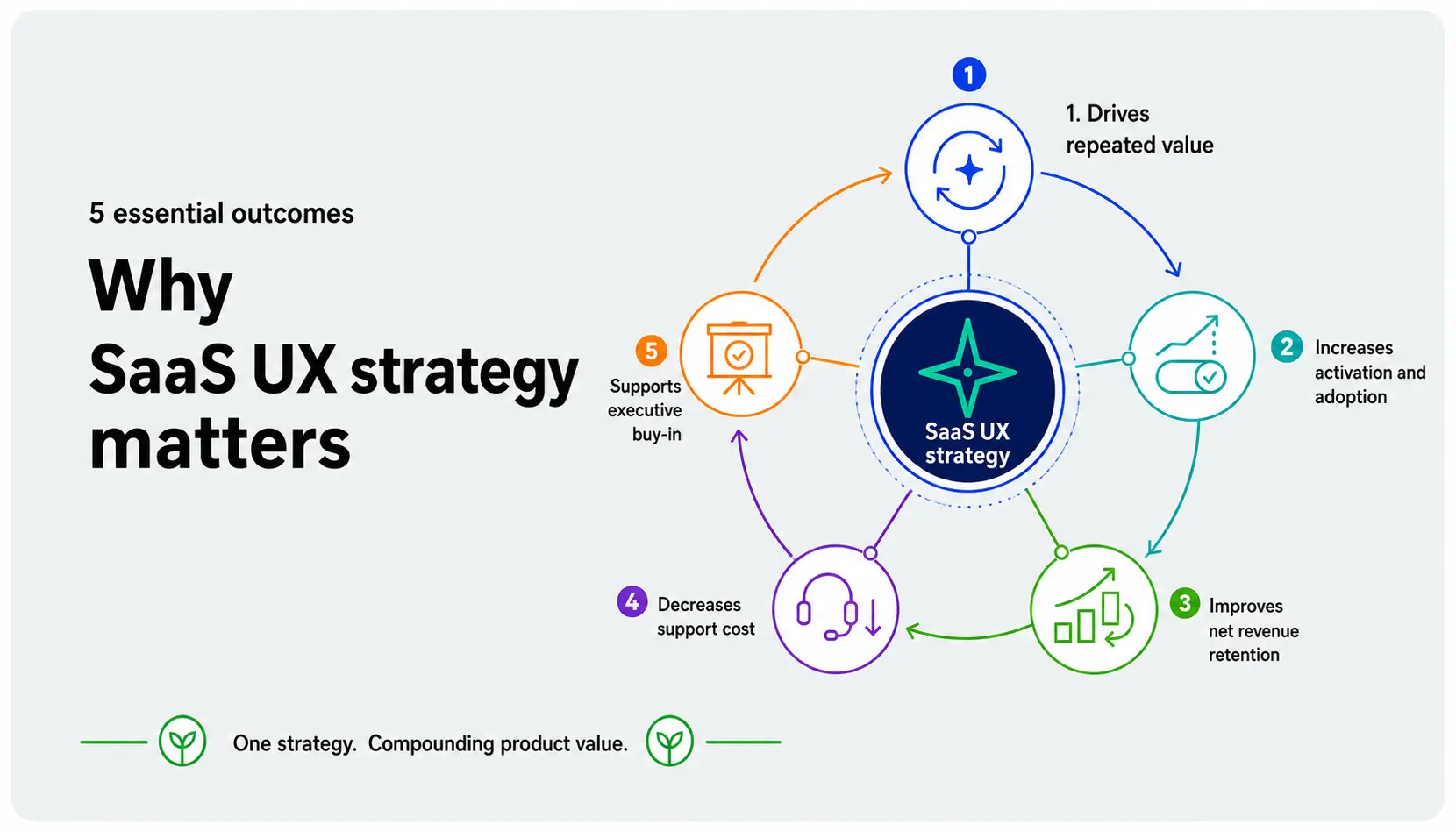
These are some of the reasons why having a strategy for SaaS UX design is important:
1. Drives repeated value
A user has to understand the product fast enough to keep going, reach a real value moment instead of just finishing a signup form, come back without being chased, and eventually trust the product enough to expand usage across their team. Every one of those moments is a design decision, whether your team treats it that way or not.
2. Increase activation rate and feature adoption
Both of these metrics show how clear and trustworthy the product feels. Clarity gets a new user to their first real outcome, and trust gets them to actually rely on a feature for real work instead of trying it once and reverting to a workaround or a spreadsheet.
3. Improves net revenue retention
Net revenue retention depends on accounts expanding faster than they churn, and that only happens when new users find value quickly. A mid-market account on a multi-seat contract makes this concrete: if the new seats can’t find value inside the first week, that expansion revenue stalls before it ever reaches a renewal call, and the same pattern repeats at every account that adds seats faster than it activates them.
4. Decreases support cost
It’s related to the above pointers, since a clear userflow and trust signals result in much less user queries flooding your customer support inbox. As a result, you’d need lesser support executives and subsequently, lower costs.
5. Supports Executive Buy-in
A UX design strategy gives the product experience a single, clear owner. That means decisions don’t drift into inconsistent patterns just because of lack of ownership. It also enables customer support tickets to become a measurable signal of current UX problems. Hence, it becomes easier to defend the investment of UX design during a budget review meeting.
How to Build a UX Design Strategy for Your SaaS Product
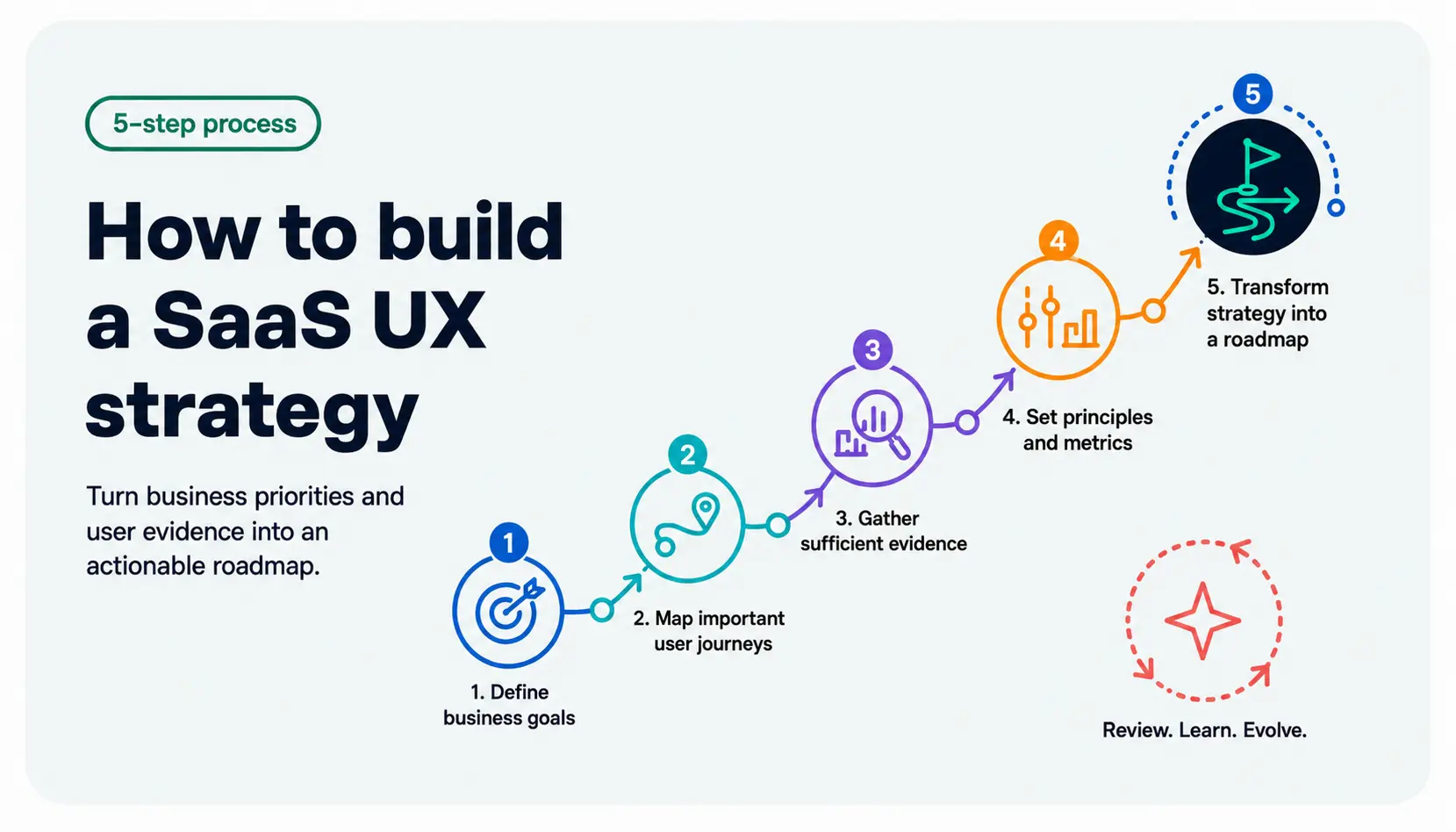
Building a UX design strategy involves 5 clearly defined steps; skipping any of these would mean a flawed approach and non-achievement of the desired outcomes.
Step 1: Define Business Goals
Start by deciding the most crucial business metric. That could be activation, trial-to-paid conversion, retention, support cost, or trust in an AI feature you just shipped. The goal you choose decides everything that follows.
For example, if trial users aren’t converting, your strategy should focus on the path from signup to the first value moment and the upgrade decision. If an AI feature gets tried once and then ignored, the strategy should focus on output trust, user control, and how that feature fits into a workflow your users already have.
Step 2: Map Important User Journeys
Not every screen deserves equal attention. Identify the most important journeys for growth, such as the first login, onboarding and setup, the core recurring workflow, collaboration and permissions, and any AI-assisted task your product depends on.
Map these journeys step by step, not as a broad lifecycle diagram. That level of detail reveals friction that individual screen reviews tend to miss.
Step 3: Gather Sufficient Evidence
A UX design strategy built on internal opinion may not seem practical or useful to your users. So, you have to pull evidence from product analytics, session recordings, support tickets, sales call notes, along with direct user interviews wherever possible.
Analytics will tell you that 35% of users drop off at a specific step. Interviews will tell you why, usually because that step asks for information the user doesn’t have on hand yet. You need both kinds of evidence to make a decision you can defend later.
Step 4: Set Principles And Metrics
Write down the principles that should guide every design decision your team makes, such as reducing the number of decisions a user has to handle, keeping AI output explainable, and giving users a clear way to recover when something goes wrong.
Then pair those principles with metrics that connect directly to growth: time-to-first-value, task completion rate, feature adoption, retention by cohort, and support tickets by workflow. Analytics show you where the friction sits. Research explains why it’s happening. Your strategy needs both.
Step 5: Transform Your Strategy Into a Roadmap
A strategy that lives in a slide deck doesn’t help anyone. Translate your findings into a roadmap that separates quick wins from larger system-level work, then revisit it every quarter as new data comes in.
That ongoing review is the real difference between a UX design strategy and a one-time exercise. It stays alive long after the kickoff meeting that created it.
Adapting Your Strategy For AI-powered SaaS in 2026
Traditional SaaS UX is deterministic. A user clicks a button, and the same thing happens every time. AI-powered SaaS isn’t. Outputs vary, confidence shifts, and trust becomes a judgment call.
Your UX design strategy has to define what good AI output looks like, when to ask for confirmation, how to handle a wrong answer, and where a human stays in the loop.
Gartner predicts more than 40% of agentic AI projects will be canceled by 2027, and a third of companies will damage customer experience in 2026 by shipping AI early. Most failures trace back to missing UX strategy, not bad models.
Buyers also raise questions about this, not just users, including where the data goes, how reliable the output is, and what happens when the model gets it wrong.
AI speeds up the strategy work itself, helping synthesize research, draft copy, and generate prototypes faster than a team can alone. It can’t replace user research or the judgment call on whether a workflow is ready to ship, especially for enterprise teams that won’t forgive getting this wrong.
Common Mistakes That Undermine a UX Strategy
UX strategies uusally fail because they become too abstract or too disconnected from product decisions. These are some of the common patterns due why UX strategy doesn’t work:
Treating UX Strategy as a Redesign Project
A redesign may be one outcome of UX strategy, but it is not the strategy itself.
If the only goal is a modern interface, the team may improve visual polish without improving activation, adoption, or retention.
A better approach is to start with the business problem. Then identify the user journeys that influence it. Then decide whether the solution is a workflow change, content change, navigation change, design system improvement, or deeper product rethink.
Letting Business Goals Overpower User Needs
Business goals matter. But they need to be translated into user value. For example, the business may want more expansion revenue. The UX question is different: what would make more users inside an account understand, trust, and adopt the product?
The business may want more AI usage. The UX question is: what task does the AI make easier, and what proof does the user need before acting on the output?
This translation layer is where UX strategy creates value.
Measuring Visual Output Instead of Behavior Change
A good-looking product can still be hard to use. UX strategy should not be judged by redesigned screens, new components, visual polish, or design speed. Measure behavior instead: setup completion, faster time to value, stronger feature adoption, fewer support tickets, higher AI repeat usage, and less training for enterprise tasks.
These are the signals that show whether UX strategy is improving the product experience in a meaningful way. It keeps design tied to growth, not aesthetics.
How Kreeya Can Help
At Kreeya we understand SaaS growth depends highly on users understanding, trusting, and repeatedly using the product. A well defined UX design strategy is what connects product ambition to that behavior.
We help your product and engineering teams decide which journeys matter, what friction to fix first, how design decisions support business goals, and how to make complex products easier to adopt.
Kreeya, has UX specialists which helps B2B and enterprise SaaS teams build UX design strategies that hold up long past the kickoff meeting. We combine user research, product thinking, and design execution to connect every screen your team ships back to a business outcome you actually care about.
For AI-powered products, Kreeya also reviews output trust, explainability, and the human-in-the-loop moments that decide whether users trust what your product tell them.
Hire Kreeya for advising and building on UX design strategy and services for SaaS growth.
