Improved operational efficiency and product adoption for a complex lab software
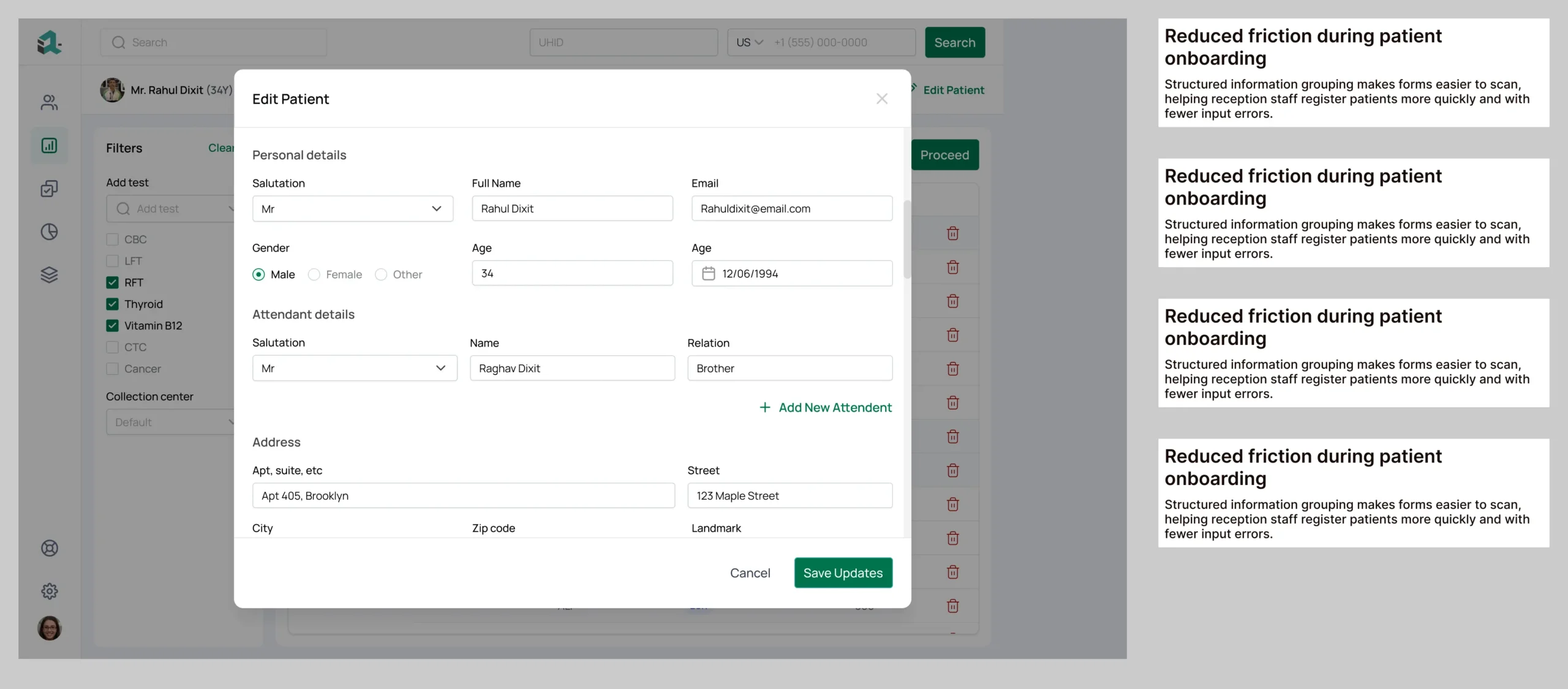
A diagnostic lab software fighting its own interface. We audited the legacy product, mapped where high-volume users were losing seconds per record, and redesigned the navigation, admin dashboard, lab reports, and patient registration flow around how labs actually work.
Context
A LIMS is the operational backbone of a diagnostic lab. It manages every step from the moment a patient walks in to the moment a report leaves the system: registration, sample tracking, test assignment, result entry, validation, report generation, and audit trail.
The people inside it are not casual users. They are operators. A single lab technician can run hundreds of samples through multiple tests in a day, which makes any small interaction cost compound into hours of wasted time per week. That same density also makes mistakes expensive: a mislabeled record or wrong field entry can cascade into incorrect reports, compliance issues, and rework.
IQLine serves four distinct roles, all working in the same product on the same shift:
Front desk / receptionist registering walk-in patients, often under queue pressure.
Lab technician entering test results, scanning barcodes, and updating sample status, frequently with one hand on a keyboard and one on a sample tray.
Pathologist or lab manager validating results, reviewing reports, and approving releases.
Admins monitoring throughput, looking at status across labs, and resolving exceptions.
The product was technically capable. It captured the data, generated the reports, kept the audit trail. But the interface was holding back every one of these roles in a different way.
A LIMS is the operational backbone of a diagnostic lab. It manages every step from the moment a patient walks in to the moment a report leaves the system: registration, sample tracking, test assignment, result entry, validation, report generation, and audit trail.
The people inside it are not casual users. They are operators. A single lab technician can run hundreds of samples through multiple tests in a day, which makes any small interaction cost compound into hours of wasted time per week. That same density also makes mistakes expensive: a mislabeled record or wrong field entry can cascade into incorrect reports, compliance issues, and rework.
IQLine serves four distinct roles, all working in the same product on the same shift:
Front desk / receptionist registering walk-in patients, often under queue pressure.
Lab technician entering test results, scanning barcodes, and updating sample status, frequently with one hand on a keyboard and one on a sample tray.
Pathologist or lab manager validating results, reviewing reports, and approving releases.
Admins monitoring throughput, looking at status across labs, and resolving exceptions.
The product was technically capable. It captured the data, generated the reports, kept the audit trail. But the interface was holding back every one of these roles in a different way.
The Problem
IQLine was carrying years of UX debt. The product had grown organically: features added, screens stacked, forms extended. The result was a system that worked, but punished the people who used it most.
Final Result
A LIMS is the operational backbone of a diagnostic lab. It manages every step from the moment a patient walks in to the moment a report leaves the system: registration, sample tracking, test assignment, result entry, validation, report generation, and audit trail.
The people inside it are not casual users. They are operators. A single lab technician can run hundreds of samples through multiple tests in a day, which makes any small interaction cost compound into hours of wasted time per week. That same density also makes mistakes expensive: a mislabeled record or wrong field entry can cascade into incorrect reports, compliance issues, and rework.
For almost 50 years Leighton Asia, one of the region’s largest and most respected construction companies, has been progressively building for a better future by leveraging international expertise with local intelligence. In that time Leighton has delivered some of Asia’s prestigious buildings and transformational infrastructure projects.